
Key Takeaways
- Technology Shift: Transitioning to advanced injection moulding machines can reduce energy consumption.
- Cooling Efficiency: Implementing conformal cooling can reduce cycle times by 18% to 26%.
- Predictive Maintenance: Moving from reactive to predictive maintenance reduces unplanned downtime, which typically costs MSMEs 5–15% of their annual revenue.
- Regulatory Readiness: Machines must comply with BIS Scheme X standards by 1 September 2026.
- Smart Capital: Customised machinery loans from Electronica Finance Limited (EFL) allow for upgrades without draining working capital.
How to Improve Your Production Efficiency with Plastic Injection Moulding Machines
The Indian manufacturing sector has been thriving and evolving steadily. And the roar of several manufacturing machines in workshops is its breath. But for many MSME owners, the roar is often accompanied by a nagging tally of rising electricity bills, fluctuating raw material costs, and the stress of a looming deadline. In this environment, efficiency might take a backseat.
As global supply chains in the plastic industry shift, Indian small businesses have a massive opportunity, but they are also facing stiffer competition and tighter regulations. If your machines are ageing, your cycle times are lagging, or your scrap rates are climbing above 3%, you are losing your competitive edge. But all is not lost. This guide helps you understand the actual levers that transform your production floor into a high-efficiency engine.
Understanding Plastic Injection Moulding Machines and Their Role in Production Efficiency
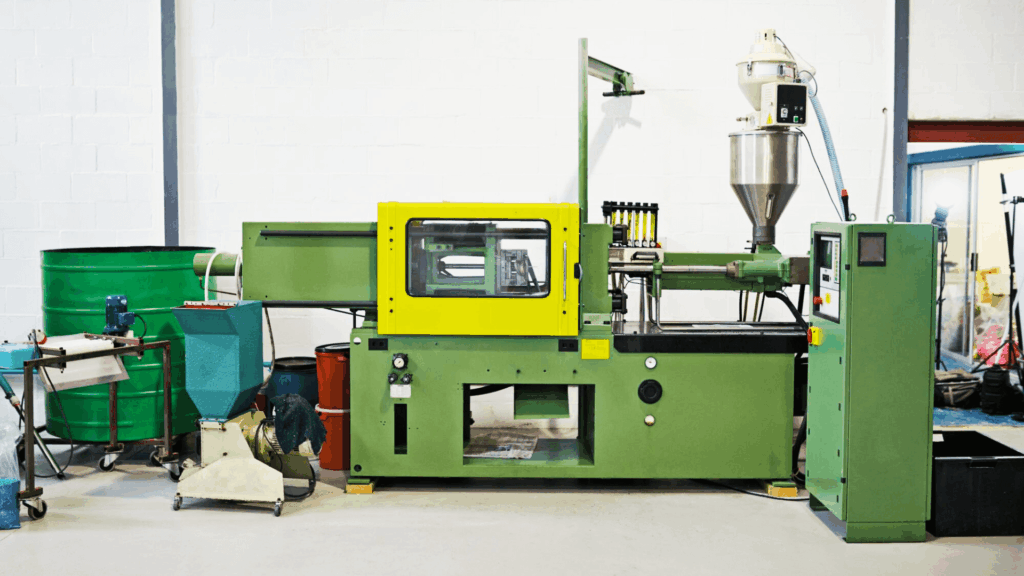
Your machine is the heart of your value chain. Traditionally, Indian MSMEs have relied on hydraulic machines for their robustness.
The Technology Behind Enhancing Production
An Injection Moulding Machine (IMM) involves complex mechanical and thermal processes, including the control of pressure, temperature, and flow during the cycle. Efficiency is won or lost during the phase transition of the polymer.
While heater bands provide initial warmth, the majority of the melt’s thermal energy is generated via shear heating. This occurs as mechanical friction from the reciprocating screw shears the polymer chains, converting kinetic energy into heat more uniformly than external conduction.
The critical technical bottleneck is the packing and holding phase. To ensure dimensional stability, the machine must compensate for the 10–25% volumetric shrinkage that occurs as the polymer crystallises. If the non-return valve is worn or the servo-response is slow, the resulting pressure drop causes internal voids and sink marks. High-efficiency production requires a machine capable of maintaining precise hold pressure to counteract this contraction.
Modern Servo-Hydraulic and All-Electric machines have changed the game. An all-electric machine uses independent servo motors for every movement: injection, mould opening, and ejection. This eliminates the need for hydraulic oil cooling, which is a major energy drain. These machines offer repeatability within +/-0.01mm, which is critical for high-precision sectors like medical devices or electronics.
Common Challenges in Injection Moulding Production Efficiency
Most shop floors suffer from hidden efficiency killers that erode margins:
- The Cooling Bottleneck: Cooling typically accounts for 70–80% of the total cycle time. Inefficient cooling leads to defects like warping and sink marks.
- Material Management: Moisture in raw materials is a silent profit killer. If ingredients aren’t baked or dried properly, you end up with brittle parts and high scrap rates.
- Ageing Technology and Maintenance: Reactive maintenance, i.e., fixing things only when they break, leads to expensive downtime. Frequent interruptions to replace worn parts are the primary cause of lost productivity in smaller units.
- Regulatory Roadblocks: As of June 2025, heavy Anti-Dumping Duties (ADD) apply to machines from China and Taiwan. Additionally, the BIS Scheme X mandate (effective Sept 2026) means non-compliant machines will eventually become legal liabilities.
Optimising Injection Moulding Machine Performance
To achieve peak performance in the injection moulding process, you need a multi-front strategy focusing on both hardware and data.
1. Strategic Mould Design and Conformal Cooling
Standard cooling channels are straight drilled, often leaving hot spots in complex part geometries. Conformal cooling uses 3D-printed (additive manufacturing-produced) inserts that follow the part’s shape. This ensures homogenous temperature distribution, which reduces cycle time by up to 26% and eliminates surface defects like flow lines.
2. Scientific Moulding and Sensor Integration
Moving away from operator intuition to data-driven settings is essential. Sensorised inserts allow you to monitor real-time data like cavity pressure and temperature. By using mould flow analysis before production begins, you can predict issues like air traps or weld lines.
3. Material and Process Parameters
With the Polypropylene (PP) Quality Control Order (QCO) effective from April 2026, using certified, consistent-grade granules is mandatory. Consistent material properties, such as Melt Flow Rate (MFI), allow you to maintain stable injection speed and pressure profiles, reducing the likelihood of flash or short shots.
Automation in Injection Moulding for Efficiency
In India, automation is less about replacing labour and more about process stability. A human operator’s speed fluctuates throughout an 8-hour shift, but a robot is constant.
- Sprue Pickers and Manipulators: These ensure that parts are removed at the same point in every cycle, maintaining a stable thermal profile for the mould.
- In-Mould Labelling (IML): Integrating labelling directly into the moulding process removes a secondary operation, saving both time and labour costs.
- IoT and Real-Time Monitoring: Modern machines use OPC-UA protocols to send performance data to your smartphone. This allows you to track Overall Equipment Effectiveness (OEE) and receive alerts for predictive maintenance before a failure occurs.
EFL’s Financing Solutions to Enhance Your Injection Moulding Machines
Optimisation of your floor productivity requires significant capital. Aand that’s where Electronica Finance Limited (EFL) comes in. We understand that for an MSME, a machine is an asset that must generate a Return on Investment (ROI) quickly.
- Speed and Accessibility: We offer loan sanctions within 3 working days, acknowledging that timing is everything when securing a new contract.
- Flexible Funding: Whether you need ₹5 lakhs or ₹10 crores, our machinery loans are designed to cover both new and pre-owned high-efficiency machines.
- Collateral-Free Options: We provide unsecured loans, ensuring you don’t have to pledge personal property to fund your business growth.
- Regulatory Compliance: EFL specifically supports the purchase of BIS-compliant and energy-efficient (Green) machinery. Investing in an all-electric machine saves energy and helps you avoid the 2025-2026 Anti-Dumping Duties.
- Digital Application Process: Through the EFL Clik app, you can manage your loan application, upload documents, and track the status.
Conclusion: Unlock Greater Efficiency in Your Manufacturing Process
Injection moulding machine production efficiency is an essential strategy. By combining high-efficiency technology like all-electric machines and conformal cooling with the discipline of predictive maintenance and regulatory compliance, you can significantly lower your cost per part.
The path to growth for an Indian MSME involves moving from reactive to preventive maintenance, regular upgrades, selection of the right systems and skills, and consistency in product quality. A machine loan from EFL enables you to stay innovative and become a high-precision manufacturer. With the right technology and a machinery loan EFL, you can turn your factory into a world-class production hub.
—
FAQs
How does automation improve production efficiency in injection moulding?
Automation ensures a constant cycle time, which is the foundation of quality. It removes human variables, reduces the risk of damage during part removal, and allows for 24/7 operation with minimal downtime.
How can I reduce cycle time in injection moulding?
The most effective way is to focus on cooling, which is the longest part of the process. Techniques like conformal cooling can shave 18-26% off your cycle. Additionally, reducing dry cycle time by using high-speed all-electric machines or optimising ejection mechanisms can provide significant gains.
Can EFL finance injection moulding machines for businesses looking to improve efficiency?
Yes. EFL offers specialised loans for both new and used machinery. These loans are specifically designed to help MSMEs upgrade to energy-efficient, BIS-compliant models that lower operational costs and meet new Indian regulatory standards.